In 1927 the prodigious filmmaker Alfred Hitchcock, by his own testimony, found his cinematic style, in that year produced which considers his first film, it contained all his major edges and distinctive guidelines. That film was
The Lodger (1927), and in that same year, the great Hitch produces the picture now commented, perhaps a bit overshadowed by the consensual success of the initially cited feature, considered his first public and artistic great success. Well, this picture also contains many ingredients to become a very significant jewel of his silent films, in the days when Hitchcock produced soundless movies. It is also probably the only film in which the British also carried out as screenwriter, he does not adapt literary work to introduce a simple story, but with a remarkably staging. Presents the great director the experiences of two individuals, two boxers, one of them is reputed invincible, no one has withstood more than one round fighting him, until he finds someone who not only reaches the second assault, but overcomes; there will be a rematch, and by a twist of fate, this fight will also serve to define who stays with a girl who has intruded between them. Hitch in this case does not use his watchword, the suspense, but that is no impediment for him to configure an excellent silent movie.
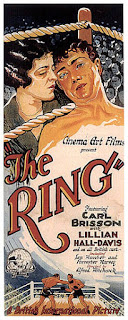


We find ourselves in a fair, diverse attractions are held, one of them being a boxer, an invincible fighter, is Jack "one round" Sander (Carl Brisson), who has that nickname because nobody ever has fought more than one round against him. Who sells tickets for the fighting is his girl (Lillian Hall-Davis), who draws the attention of Bob Corby (Ian Hunter), he gets encouraged to challenge Jack, resists more than one round, and defeats him. The defeated boxer is now out of work for being overcomed, but Bob's agent, who is heavyweight champion in Australia by the way, offers a job, being the sparring partner for the champion. Jack takes the job, not knowing that Bob is courting his girlfriend, who without much hestitation kisses and allows that approach. After marrying his girlfriend, Jack starts his new job, exchanges blows in the workouts with Bob, while noting how he gets closer to his new wife, she never opposes it. Jack, tired of it, wants to challenge the professional boxer, and for that trains hard and goes up in the categories of pugilists, until he gets a fight whose victory would allow him to challenge the defending champion Bob. Things do not change, the indecisive lady still appears elusive with her husband, while the Australian champion makes her ostentatious gifts and spends a lot of time with her, but when Jack wins his fight, will have a final chance to face arch-rival.


The first images of the film gives us a direct indication of what we will see on the picture, when frantically we enter the world of the fair, and good Hitchcock dizzily chains shots of the different entertainments offered there. Low angle, high angle shots, movements of a mobile camera, even a camera emplaced in one of the games, achieving an effect of rocking swinging, a variety of angles in his shots. Everything is presented to us in a stream of images that gets actually that vertigo, and as well I read in a review, more than one might get remembrances of the old last century's Soviet cinema. After that compelling presentation, another resource we observe, with the face of the female protagonist hovering in an overlayed shot, all denoting what looks like an effervescent mood in the filmmaker, because a few minutes later, more faces appear using that technique. Unlike many other exercises by Hitchcock, now, instead of a start that immediately weaves an intrigue or mystery, we have the flashy visual exercise. It seems as if Hitch had self discovered, having reached the summit for the first time with
The Lodger, almost we felt a filmmaker who wants to eat the world, that feels capable of cinematic prowess, and ventures to do so without fear and with enthusiasm. Even a correct construction of his images is seen, greater sharpness in the frames that apparently is due in part to good financing, a budget that could allow Hitch a pleasant shooting, as reflected in that work so well done, which certainly does not lack some sequences markedly dark, as when appears the pythoness telling the girl her fortunes. But Hitch furthers his effervescent enthusiasm as filmmaker who began to build his cornerstones, experiment with his camera, we see reflected shots in the water, with the shimmery effect given by the liquid, added to repeating overlayed images. In the wedding sequence, while putting us in the perspective of the drunkard Jack's coach, a distortion of the image resembles his drunkenness, we observe a filmmaker experimenting with the sufficiency of who is aware of his capabilities, Hitchcock felt ebullient.


When Jack goes mad with jealousy, again the reality is distorted, the darkness plagues everything, that distortion will combine to overlayed shots, and that dementia, in which are shown images of hands playing the piano and string instruments, of a disc rolling quickly, makes us almost hear the wildness and hubbub in a silent film, recreates an expressionistic and chaotic world of jealousy. This is one of the most visual films of the author, his images are very significant, for example she, hiding the bracelet, holding in her hand the suit of the king of diamonds, she knows it represents Bob, and always hiding truth regarding the bracelet, caresses the suit. Moreover, when she gets married to Jack, the bracelet -which is an obvious symbol- eloquently falls almost to touch the wedding ring, Hitch gets his images to speak, always did in his films, and at the stage of silent cinema is when that feature is more powerful. Hitch always knew to tell wordless, we saw examples in The Lodger, and now we will see how the signboard -whose content is changing, it is not kept static- announces fights while at the same time tells us the rise of Jack, who goes climbing categories to challenge his opponent. Hitchcock took his first steps as a director led by producer Michael Balcon, began his independent career just three years before the arrival of sound in 1928 with The Jazz Singer. He never narrated in a completely conventional way, even in the stage of silent film, we see that he was eminently a modern filmmaker, but he knew to equally excel in silent films. Also is pleasing to detect the known detail-orientation by Hitch at this stage of his career, a filmmaker who paid attention to small details to enrich the picture, like seeing the posters announcing the rounds, the poster of the first round is very worn and dirty, showing the constant use is given; on the contrary, the poster for round 2 is bright as new, reporting that is indeed the first time it is used, no one had ever come to a second round with "one round" Jack. Another similar resource is when Jack, excited for having won the fight that will allow him to opt for the championship, wants to toast with his wife, but the champagne bubbles disappear, giving us to understand how much they have waited for a woman who is having fun with her husband's opponent.


As noted, this feature is one of the few, and I understand, the only one in which Hitch serves as screenwriter, feels almost a miracle that the director does not adapt a literary work, which was one of his biggest edges in his film career. However, when seeing the picture one understands perfectly that, it is noted as in almost no other film of his that narrative, since there are so little dialogue, certainly nonverbal language is everything. Without resorting to his just discovered suspense, now love triangle looms as the main vertex, and soon the stage has already been outlined, and the triangle has its three corners, the two boxers, and amidst the girl. A girl who incidentally is one of the few exceptions as brunette girl protagonist in a picture by Hitch. At one point, in order to introduce his film, puts us in the perspective of an assistant to the fair, when at the beginning of the final round of the first fight between Jack and Bob, the dark silhouettes of the other attendees impede vision and passing, with simplicity creates that feeling that we are also on the site. We will even see some cameras recording the final fight, as a sort of nod to his profession, it feels as if the filmmaker was having fun, as if he happened to be having a good time during filming, and who knows the artist, knows that's something that characterized him. The humor could not be absent in a film by Hitchcock, and is embodied mainly in the figure of Jack's coach, who performs delirious nonsense when he delivers the rings at the time of marriage, later getting drunk during the wedding reception. Hitch never lacked humor in his features, nor in darkest ones nor in the more benign, and we almost feel him solacing when we see the coach first picking his nose vulgarly, drinking heatedly afterwards, since most of the comic load of the movie rests in the colorful character. In the final sequence, the final fight, much of previously appreciated is epitomized, distorted frames, overlays, medium shots, american shots, closeups, all assembled in a montage that captures the particular dynamism and movement of a boxing fight, multiplied dementia. Teaches lecture the director for alike subsequent film exercises such as
The Set-Up (1949) with the great Robert Ryan, with the photogram of fallen fighter framed behind the opponent's legs; also we feel some noticeable halos that
Raging Bull (1980) would adopt, with travellings that capture the severe vertigo of combat; masterfully captured sequence. What a film exercise, is a rarity in the Hitch oeuvre, with boxing as one of his subjects, without suspense, but the titan had awakened, there was no going back, was born one of the greatest names in the history of cinema.


 |
| The ring (1927) |
 |
| The Set-Up (1949) |
 The great Alfred Hitchcock, in his time as a filmmaker in the silent period of this art, made about almost ten features, when was still looking for his signature style as the immortal master of suspense, defining his main artistic cornerstones. It was already the mythical year in which the greatest revolution came to the movies, the sound had arrived to stay, to completely reconfigure the film scene, and the great Hitch was thus materializing his last silent exercises. With this picture begins the British his link with his new producer, British International Pictures studios, and after leading Decline (1927), adapted a literary work again, the play of Eden Phillpotts, to introduce a simple story, hilarious, in which a mature man, becomes widowed, after the death of his wife, decides to find a new mate for him, and starts searching for the female, draws up a list of potential prospects, and, aided by his housekeeper, is launched to woo, obtaining one each rejections every time. But when it seems that his target will not be met, thoughtlessly he finds what he wanted in the least expected person. Unusual exercise in the filmography of prodigious Hitchcock, a pleasant comedy, which of course does not approach the biggest films of this remarkable director, is certainly a rarity, but being a silent film of Hitchcock, already has great appeal to be appreciated.

 In a country house, we see the farmer Samuel Sweetland (Jameson Thomas), passing through a difficult time, his wife has just passed away. He lives with his housekeeper, Araminta Dench (Lillian Hall-Davis) and his butler, Churdles Ash (Gordon Harker); all attend shortly after the wedding of the daughter of Sweetland, after which, the farmer, assisted by his loyal "Minta", elaborates a list of four possible candidates to become his new wife. Then initiates the courtship of each, starting with the widow Louisa Windeatt (Louie Pounds), to whom lets know his intentions, obtaining negative from the widow. Then continues with Thirza Tapper (Maud Gill), who although at first seems to have a different attitude towards the proposal, finally also rejects him, growing frustration in Sweetland. In a fun and crowded meeting, he makes his third attempt, the choice is Mary Hearn (Olga Slade), a woman whose answer is not only negative, but even laughs at the farmer, who responds with some insults, generating her a hysterical attack. The whole town already has learned about the search of the widower, he woos the fourth one, Mercy Bassett (Ruth Maitland), again getting a rejection. Eventually he will find a woman who genuinely loves him, and when two women come back, get surprised to find the farmer happily paired.


 The initial image of the picture presents a visual summary of the environment where everything will happen, we see country wildlife, ducks, dogs, cattle, everything surrounding the home, the farm of Samuel; we will see nice images of animals, and then dozens of hunter dogs, field, outdoors, a film that even with these elements goes declaring itself as atypical work of its author. Apparently there are in circulation more than one version, more than one cut of this film, and the film viewing in which this criticism is based on, is a cut of 97 minutes, lower in almost twenty minutes to another version I understand there is. And perhaps is because of that missing material, that we feel a certain frenzy in the early sequences, in which quickly, within a few minutes, the farm is shown, the death of the farmer's wife as well, and also the marriage of the daughter, is possible that in the extended version we might not feel that certain rush of the first few minutes. It is a certainly atypical work of Hitch, it's a comedy, something far more benign to what the master usually did, far from the suspense that would turn him into a legend; however, it is also true that comedy, the comic charge is something that was almost never absent in the films of the British, we always find batched hilarity during the filmmaker's features, and in this case is disseminated in part on the occurrences and certain clumsiness of the housekeeper of one of the courted ladies. Nevertheless, as this is completely a comedy, it is noted that this is a foreign field to the greatest feats of the notorious filmmaker, without being a loose filmic exercise; we are simply witnessing a stage when the creator was still finding himself, and while an important step in this direction was took with The Lodger (1927), discovering the suspense as the main asset of his films, it is evident that the then novel Hitchcock continued in the process of defining his style, as it was largely in his time of silent films.