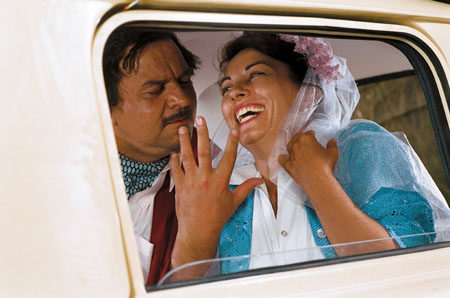
Having finiushed Emir Kusturica
Life Is a Miracle (2004), a couple of less-footage works would see the light, a segment of film and a television episode, before three years later the now-comented work would be as well finished. While the picture maintains many of the constants in the cinema of the Bosnian, it was one of which most criticism earned to the director, and certainly, although not pleasant to recognize for this writer, it is one of the less-quality films of the acclaimed director of
Underground. For the first time, always speaking from my perspective of course, we see Kusturica, whose cinema, what he represents, is overwhelmed by the way, the style in which he captures that; this last statement is something that will be detailed in later lines. The film depicts the story of a teenager, in contemporary Bosnia, who lives in a remote village, whose only inhabitants are himself, his grandfather, and the woman teacher at the local school. When the school is closed for lack of students, and grandfather convinces himself he is near death, makes the young fellow promise he will go to the city, will sell his prized cow, and get, among other things, a religious icon and a wife. The story is that, simple, similar in some respects to previous works of the director, but, again, something changes in the Balkan director cinema that makes this film probably the weakest of his creations.


From the start, as always in his films, we appreciate much of what we will see throughout the film, the bizarre occurs quickly, with so singular both awakening as having breakfast of Tsane (Uros Milovanovic). The topic, a young man whose life will experience radical change, it is not strange -
Gypsy times (1988) executed with impeccable artistic results an alike formula-, but that existential contrast, this change of life will not be represented with sublime skill and mastery. If
Arizona Dream (1992) the reason of a certain distance to usual, and certain weaknesses in the picture seemed to be blamed to the change of country and production for Kusturica, now that reason is no longer so clear, or at least seems to be nothing other than a filmmaker who seems to have lost the inspiration, that touch of magic that turns a work of art into something else, something very full of humanity, reality; that apparent loss of inspiration seems as well to presage the significant drop in productivity of the Bosnian, it almost explains this is his latest film in nearly a decade. And, as said, many, or all of his guidelines are in this film -his sharpness, humor, all attenuated-, but it feels a lack of strength between them, a lack of cohesion that in previous pictures made so compact his audiovisual and artistic proposals. This absence of amalgam makes the feature wobbling so much that the film is perceived as a parade of estrangement, of absurdities -usual by the way in the Bosnian-, but all uncoordinated, total weakness and disorder, atypical for an Emir work.


On this Kusturica feature, from the initial instants we nottice that his portraits no longer have the same strength as other times, the strength and power of his characters and situations has declined: the form, exaggerated with no moderation, exceeds and overshadows the background, which portrays itself. Now, for a filmmaker of the caliber and unique orientations as the Bosnian, is nothing unusual that the style, almost always bizarre, noisy, sleazy even, come to overshadow the story, to "mask" (as the director himself has said) the background with both colorful and alienation that almost always exceeds it, in a greater or lesser extent, depending on the palate to savor the film. On this occasion, all of that continues compliance, it is basically a picture with more of the same old Bosnian, however the bizarre and alienation reach levels which in effect accuse the hype that so willingly seem to stir at him his detractors; the force when portraying his people, his gypsies, no longer shines with so strong and determined assertiveness (and we miss so much this form of plot them). Now, since portraying much of the events in the city, away from his usual habitat, the field and those Gypsies whom he loves -and whose human drawings were so effective in other times-, the film by Kusturica seems to sink, seems to lose that link that so naturally and with so much strength filled the screen on other occasions. In the city, without its people, Kusturica style drowns, with no cohesion between his usual extravagance and those city clothes, entertainments in karaoke; they lose force his characters, a lack of rootedness to portray them is noticeable, and his film ends up becoming innocuous, weak, artificial.

A more luminous photography work actually also collaborates the final aesthetics of the picture to be founded with the general atmosphere of it, it feels lighter, more superficial, weaker and with less force than previous occasions with the director. And even music, such a key element in the Balkan other works, seems to collaborate as well with the aforementioned final product; with close-to-rock-and-pop contemporary notes, very differente sounds comparing his previous films, generates too light environment, which, added to the general weakness of the feature, ends up setting a universe without a
soul, without a genuine reality behind them, as always used to happen in his best films. This unfortunately even reaches his usual and inevitable surreal touch, this playful but powerful in other opportunities Surrealism is now badly risible when we see an individual flying through the skies for most of the film, or other one being shot, but without thereby interrupting sexual intercourse. Or, much worse, when we see a bulky subject be inflated like a balloon and then sail through the air when deflating (...). Kusturica's films, always prone to excesses, to the absurd and unreal -but somehow all arranged and, although it sounds antagonistic, with a well defined north- , had never reached these extremes. Peeps strongly that accused exaggeration, that hyperbolic caricature-building that no longer generates as much astonishment as fun, but rather strangeness to witness such exercises that approach a cartoon, a children's product. His desire for eccentricity seems to have overpassed him, and certain scenes will generate disbelief. Nobody is perfect.

Elements and political dyes can never be absent in the films of Kusturica, and again we appreciate warm winks to Bosnian old acquaintances. In his particular style, there's a sort of tribute to Russia, the proud Soviet anthem rings, amid a laughable situation with the young Tsane watching libidinously to Bosa the teacher (Ljiljana Blagojevic, beautiful and then young Dolly Bell when the director debuted) take a bath through a spotting scopes. There is also a nod to the Yankee culture, with
Taxi Driver images being witnessed, and mafioso Bajo (Predrag Manojlovic) wanting to build the Balkan twin towers; his love for football, with some joke regarding Ronaldinho, will not be absent either: it certainly is a Kusturica film, but is the
less Kusturica of his films. Manojlovic is brought back, his usual actor, and his interpretation, full of exaggerations and histrionic excesses, is one that most feeds the criticism, a source of where drink detractors. Aleksandar Bercek brings greater balance incarnating the hyperactive and false dying grandfather, while Marija Petronijevic also scores as the beautiful Jasna, the epiphanic female of Tsane. Although even "collect" elements of previous films -the turkey from
Time of the Gypsies, some melody of the same picture, usual echoes in their filmes-, this work finally can not help being a false step, a setback, as some cruelty has called it; although I do not consider this film a failure, it is definitely his least successful film, with all its gadgets and norths present, but all working with less effect than ever. Kusturica finishes his film with another element very own of him, the wedding, a double wedding, seen with the same sad result than everything else, tasteless and almost puerile, such as how the happy ending comes, as if nothing happens, as the feature itself. Yes, it is a misstep for Kusturica, but a step in false forgivable for a filmmaker who has earned surplus to be a prominent personality in the contemporary film world as he is.


 Last film to date that has produced the once so
remarkable and appreciable Polish Roman Polanski, a film that continues
sticking to the guidelines showed in his latest works. This time Polanski
adapts a work that has multiple origins, having its primal root in the novel written by Austrian Leopold von Sacher-Masoch, sordid work composed in several sections
that gives the name to the masochism stream. Later, David Ives would take one
of those sections to adapt the novel into a play, and finally this yankee would
work with Polanski himself to develop the script of the film. Minimalist film, another one of this kind of exercise from the Polish throughout his career, the picture displays a simple story, the brief episode of a theater director who makes auditions for a
new female role, obtaining only deceptions of applicants to the part. Until a
singular female appears, resolute and determined to get the role, but in that track, director and actress find themselves in the midst of a peculiar situation, when the
part to interpret is extending beyond the fiction and both artists suddenly
inadvertently bring the work to plane of real life. New sort of psychological
study by Polanski, and new adaptation of a play, like the immediately preceding
Carnage (2011), setting a decent, discreet but decent film in what is already
eying as the final stretch of the career of this great filmmaker.
Last film to date that has produced the once so
remarkable and appreciable Polish Roman Polanski, a film that continues
sticking to the guidelines showed in his latest works. This time Polanski
adapts a work that has multiple origins, having its primal root in the novel written by Austrian Leopold von Sacher-Masoch, sordid work composed in several sections
that gives the name to the masochism stream. Later, David Ives would take one
of those sections to adapt the novel into a play, and finally this yankee would
work with Polanski himself to develop the script of the film. Minimalist film, another one of this kind of exercise from the Polish throughout his career, the picture displays a simple story, the brief episode of a theater director who makes auditions for a
new female role, obtaining only deceptions of applicants to the part. Until a
singular female appears, resolute and determined to get the role, but in that track, director and actress find themselves in the midst of a peculiar situation, when the
part to interpret is extending beyond the fiction and both artists suddenly
inadvertently bring the work to plane of real life. New sort of psychological
study by Polanski, and new adaptation of a play, like the immediately preceding
Carnage (2011), setting a decent, discreet but decent film in what is already
eying as the final stretch of the career of this great filmmaker.

 A somewhat uncertain music, somewhat dark
takes us to the interior of a theater, on a night where we see the director Thomas (Mathieu Amalric), who is having hard times not getting the actress he needs
to play the role of Vanda in his new play. Then, arrives late an actress who has the
same name (Emmanuelle Seigner), dressed very appropriately to sadomasochistic
role she wants to represent. Reluctant at first, Thomas gives in the momentum of Vanda,
she displays the audition, and he is shocked to see the strength and naturalness of Vanda
to play the role. The lines of the role played are advancing, as well as the admiration of
Thomas for his new aspirant, to the level that pays homage, not only
artistically. Like the male character of the literary work, the director
submits completely to the will of Vanda, although in the play that submission is
extended for a year. Various situations will happen, the director shares some
events of his personal life, always with her in command and control of what
happens, even managing the woman the lighting of the theatrical precinct, being Thomas unable to control the changing roles in the reality. As the director assumes the
role of a slave, she dominates more and more, crossdresses him into Vanda, and
finally leaves him alone and tied inside the theater.
A somewhat uncertain music, somewhat dark
takes us to the interior of a theater, on a night where we see the director Thomas (Mathieu Amalric), who is having hard times not getting the actress he needs
to play the role of Vanda in his new play. Then, arrives late an actress who has the
same name (Emmanuelle Seigner), dressed very appropriately to sadomasochistic
role she wants to represent. Reluctant at first, Thomas gives in the momentum of Vanda,
she displays the audition, and he is shocked to see the strength and naturalness of Vanda
to play the role. The lines of the role played are advancing, as well as the admiration of
Thomas for his new aspirant, to the level that pays homage, not only
artistically. Like the male character of the literary work, the director
submits completely to the will of Vanda, although in the play that submission is
extended for a year. Various situations will happen, the director shares some
events of his personal life, always with her in command and control of what
happens, even managing the woman the lighting of the theatrical precinct, being Thomas unable to control the changing roles in the reality. As the director assumes the
role of a slave, she dominates more and more, crossdresses him into Vanda, and
finally leaves him alone and tied inside the theater.

 The bizarreness of the picture is seen from the
beginning, with the musical accompaniment that has shades of dark, of bizarre
atmospheres, according to the nature and subject of the film, while, with a traveling
advance both lens and viewer in the shady night by the street, enters the as well dark theater, we get prepared for the show to witness. The music is rather scarce for the film, appears in dribs and drabs, but appears to generate certain
environments, especially in times like successive approaches between director
and directed. Aesthetically there will be pleasant surprises, attractive
moments: when seeing over a painting, more than one painting, especially at the end
of the tape with many historical images by painters such as Botticelli,
among others, representing famous females, real and mythological. There are sequences -few, but there are- where we actually appreciate a chromatic domain, a powerful light-and-shadows game that almost seem to have drawn these principles from the paintings, the effect of
colors and contrasts, which definitely enhances these sequences, and enriches
the aesthetics of the film. So we observe the domineering and unbridled Vanda coming almost out of nowhere, out of darkness, moving toward the light and displaying a
colorful costume at the theater, in a nice resource within austerity and
economy of resources of the film. Good atmosphere for the environment to create, the environment where reality and fiction line breaks, and where those two only
players interact.
The bizarreness of the picture is seen from the
beginning, with the musical accompaniment that has shades of dark, of bizarre
atmospheres, according to the nature and subject of the film, while, with a traveling
advance both lens and viewer in the shady night by the street, enters the as well dark theater, we get prepared for the show to witness. The music is rather scarce for the film, appears in dribs and drabs, but appears to generate certain
environments, especially in times like successive approaches between director
and directed. Aesthetically there will be pleasant surprises, attractive
moments: when seeing over a painting, more than one painting, especially at the end
of the tape with many historical images by painters such as Botticelli,
among others, representing famous females, real and mythological. There are sequences -few, but there are- where we actually appreciate a chromatic domain, a powerful light-and-shadows game that almost seem to have drawn these principles from the paintings, the effect of
colors and contrasts, which definitely enhances these sequences, and enriches
the aesthetics of the film. So we observe the domineering and unbridled Vanda coming almost out of nowhere, out of darkness, moving toward the light and displaying a
colorful costume at the theater, in a nice resource within austerity and
economy of resources of the film. Good atmosphere for the environment to create, the environment where reality and fiction line breaks, and where those two only
players interact.


 We never left that pairing of actors, in this
sense, is the most minimalist picture of Polanski, the one which fewer resources needed to be produced, because although is too well known to the connoisseur of the polanskian work his minimalist inclination, his taste to make films with minimal resources, this is the
opportunity where that proclivity gets to climax point. Thus, we saw his lineament in Knife in the Water (1962), continuing in Repulsion (1965) and Cul-de-sac (1966),
his early films, where two or three characters, even a single character in the
case of Repulsion, is responsible for all the action, is the receptacle and
simultaneously engine for major events. In turn, in those films everything is triggered in minimal spaces, minimal and low scenarios, and all this feeds
powerfully the minimalist style that was always in Polanski films. Then, for three
decades he was away from these guidelines, to return lukewarmly to them in appreciable
Death and the Maiden (1994); again abandon those guidelines up the feature to the
beginning said, Carnage, and stringing the Polish filmmaker, decades later, two films of this
nature in a row. But, as stated, this feature carries those two directives to the peak,
when the duo of performers are the only human elements that we see, and when the
small theater venue is the only scenario seen during the ninety minutes of
footage. Polanski maximizes some of his most important guidelines, certainly returns to its
beginnings while still taking refuge in the theater (Carnage is also
a theater piece).
We never left that pairing of actors, in this
sense, is the most minimalist picture of Polanski, the one which fewer resources needed to be produced, because although is too well known to the connoisseur of the polanskian work his minimalist inclination, his taste to make films with minimal resources, this is the
opportunity where that proclivity gets to climax point. Thus, we saw his lineament in Knife in the Water (1962), continuing in Repulsion (1965) and Cul-de-sac (1966),
his early films, where two or three characters, even a single character in the
case of Repulsion, is responsible for all the action, is the receptacle and
simultaneously engine for major events. In turn, in those films everything is triggered in minimal spaces, minimal and low scenarios, and all this feeds
powerfully the minimalist style that was always in Polanski films. Then, for three
decades he was away from these guidelines, to return lukewarmly to them in appreciable
Death and the Maiden (1994); again abandon those guidelines up the feature to the
beginning said, Carnage, and stringing the Polish filmmaker, decades later, two films of this
nature in a row. But, as stated, this feature carries those two directives to the peak,
when the duo of performers are the only human elements that we see, and when the
small theater venue is the only scenario seen during the ninety minutes of
footage. Polanski maximizes some of his most important guidelines, certainly returns to its
beginnings while still taking refuge in the theater (Carnage is also
a theater piece).

 In that sense, the director, when adaptating theater to cinema, two art so close, renounces the showiest
artifices of seventh art, austerity of resources is also reflected in that plane.
But obviously, an adaptation thus combines the virtues of both theater and cinema,
with the wonders that can be done in montage and with a good shots work (which
Polanski certainly gets), and we will see some expressive framings, empowering
at times the female for her location in the shots; light low-angle shootings, shots and reverse shots, and other framings again attest to this. It is curious that
Polanski, without being a theater man, in a moment that is expected as the
closing stage of his career, performs this kind of exercise, and do it with
quality. Polanski continues turning to his wife, his wife Emmanuelle Seigner,
who frankly could have some excess of years for this film; she still retains much of
its solvency and her antecedents in the sordid films by her husband (Frantic 1988,
obviously the remembered Bitter Moon 1992, and regrettable The Ninth Gate 1999) were
the main arguments for, fourteen years later, starring in a tape of the Polish again.
That said, the Seigner retains many of her virtues, but has lost freshness over
the years, and although his performance does not clash or disappoints, maybe a
younger actress could have performed the same or better job. Mathieu Amalric
complete the reduced acting cast, and he feels achiever in his double-faced and
almost always subjected role.
In that sense, the director, when adaptating theater to cinema, two art so close, renounces the showiest
artifices of seventh art, austerity of resources is also reflected in that plane.
But obviously, an adaptation thus combines the virtues of both theater and cinema,
with the wonders that can be done in montage and with a good shots work (which
Polanski certainly gets), and we will see some expressive framings, empowering
at times the female for her location in the shots; light low-angle shootings, shots and reverse shots, and other framings again attest to this. It is curious that
Polanski, without being a theater man, in a moment that is expected as the
closing stage of his career, performs this kind of exercise, and do it with
quality. Polanski continues turning to his wife, his wife Emmanuelle Seigner,
who frankly could have some excess of years for this film; she still retains much of
its solvency and her antecedents in the sordid films by her husband (Frantic 1988,
obviously the remembered Bitter Moon 1992, and regrettable The Ninth Gate 1999) were
the main arguments for, fourteen years later, starring in a tape of the Polish again.
That said, the Seigner retains many of her virtues, but has lost freshness over
the years, and although his performance does not clash or disappoints, maybe a
younger actress could have performed the same or better job. Mathieu Amalric
complete the reduced acting cast, and he feels achiever in his double-faced and
almost always subjected role.


 The character of theater director is eying almost as an extension of filmmaker Roman himself, who probably felt
affinities between himself and the flamboyant theater director who is
completely subjected to the will of the fiery female who directs his work. Sadomasochism from literary novel goes portraying from Vanda's provocative and daring clothing, getting at some point in lower garments, and becoming the dominator of
everything. In that sense, the psychological game is portrayed, the work of von
Sacher-Masoch, of course, is full of sordidness -not in vain sadomasochism was named after the author because of this novel-, dark and bizarre issues, it moves to
film, the director has a traumatic experience with a whipping aunt, and he acquired a taste for it. The psychological game is severe, the exchange of roles is
absolute, starting with her managing the theater lights, then fiction gets beyond
its scope and moves to reality: she assumes the role of psychiatrist and he is
placed on the couch, the figures and theatricality deployed reinforce powerfully that tense psychological atmosphere. Gradually their roles are exchanged and
that is also reinforced by the correct camera work mentioned, it is pretty clear who's
boss and who obeys. If it was already outlined a psychological study in Carnage,
with parents losing control, with this film indeed new heights are reached. The
tape is nice, can fool its apparent discretion, but is powerful at some times, I like
the idea of making theater
from cinema, that game between the two arts that makes the filmmaker. However, it
feels like a feature already
in the old age of its director, psychology becomes important and strength, other aspects
of his films seem to be decreasing already since decades. Not having an
upcoming project confirmed by Polanski, is this his last production available,
noticeable, pleasant, perhaps not the best of its creator, but enjoyable.
The character of theater director is eying almost as an extension of filmmaker Roman himself, who probably felt
affinities between himself and the flamboyant theater director who is
completely subjected to the will of the fiery female who directs his work. Sadomasochism from literary novel goes portraying from Vanda's provocative and daring clothing, getting at some point in lower garments, and becoming the dominator of
everything. In that sense, the psychological game is portrayed, the work of von
Sacher-Masoch, of course, is full of sordidness -not in vain sadomasochism was named after the author because of this novel-, dark and bizarre issues, it moves to
film, the director has a traumatic experience with a whipping aunt, and he acquired a taste for it. The psychological game is severe, the exchange of roles is
absolute, starting with her managing the theater lights, then fiction gets beyond
its scope and moves to reality: she assumes the role of psychiatrist and he is
placed on the couch, the figures and theatricality deployed reinforce powerfully that tense psychological atmosphere. Gradually their roles are exchanged and
that is also reinforced by the correct camera work mentioned, it is pretty clear who's
boss and who obeys. If it was already outlined a psychological study in Carnage,
with parents losing control, with this film indeed new heights are reached. The
tape is nice, can fool its apparent discretion, but is powerful at some times, I like
the idea of making theater
from cinema, that game between the two arts that makes the filmmaker. However, it
feels like a feature already
in the old age of its director, psychology becomes important and strength, other aspects
of his films seem to be decreasing already since decades. Not having an
upcoming project confirmed by Polanski, is this his last production available,
noticeable, pleasant, perhaps not the best of its creator, but enjoyable.