Hitchocck continued during the thirties of the last century evolving and developing as a talkies filmmaker, with filmic exercises that still were not near the higher summits that the director would achieve some years later, but it can be recognized some of his main features already. If in previous exercises to this picture Hitch had been ostensibly moved away from his most recognizable imprint as master of suspense (not to go further, we see it on immediatelly previous
Rich and strange, released the same year), with themes and topics far from mysteries, intrigues and uncertainties, recovers in the present work a bit of his innermost essence the director. In order not to lose the custom, Hitchcock once again adapts to the cinema a new literary work, a new theatrical piece, written by Joseph Jefferson Farjeon, to capture one of the shorter films that he ever shot, with the simple history of a group of thieves, a band that takes refuge in an abandoned house, being followed by a detective; when a young woman, member of the gang, prevents the detective from being killed, in love with him, an intense persecution to recover a jewel will begin. Another picture with which, without being the best work of the director, you can follow the evolutionary path of the filmmaker.


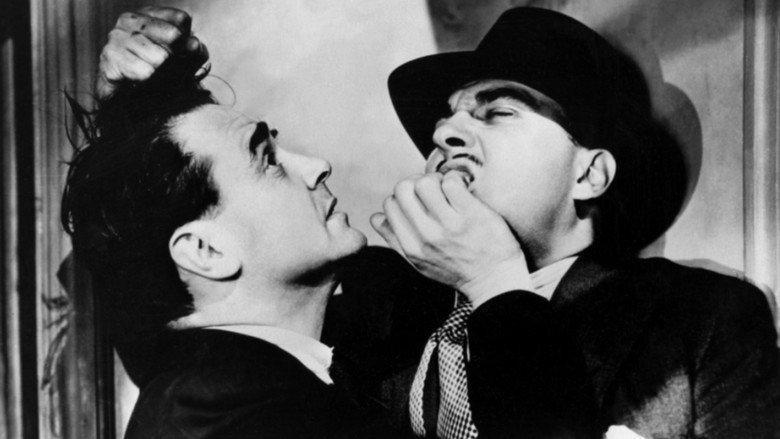
In an undetermined place, two individuals are in a lonely location, it is a stormy night, they wander the shady corners of what appears to be an uninhabited house. As they walk through the interiors of the abandoned house, they find the corpse of a man, not quite knowing what has happened. They are thieves, they are hiding in that abandoned address, which is the number seventeen of some avenue in England. Among the refugees is Ben (Leon M. Lion), and the young woman Nora Brant (Anne Gray), they are hiding with their cohorts, they have stolen a valuable necklace, but they know that a police officer is tracking them. Appears then the detective, Barton (John Stuart), who suspects what is happening, but there is no certain, and begins an investigation, searches the house, as well as everybody, not finding any definitive evidence. But Barton is getting closer to the truth, in the numerous band are also Brant (Donald Calthrop) and Henry Doyle (Barry Jones), and when the detective has identified the band and is going to arrest them, they are about to eliminate him, but Nora helps Barton, and he survives. It follows an intense persecution, Barton follows the band that flees in train, they carry the necklace, but the detective manages to reach them, the jewel has been recovered, and even the romance between Barton and Nora has been born.


Hitch recovers some of the dark directives of his cinema immediately in the present film, when the beginning of the same one is tenebrous, with parsimony initiates the movie, but plagued of mystery, when we see one of the members of the band entering the dark abandoned house on a hectic night. But while entering the location, and always treated everything without words, the rhythm changes, as well as a lights-and-shadows management that immediately generates suspense, and also the camera work and montage will finish setting this brief but effective sequence. The mentioned management of lights and shadows will be extended to the whole feature, being a more than appreciable resource, contributing decidedly in the final dark aesthetic of the film, with the human shadows that project in ways almost unreal by all the house, looking sometimes as another character in the movie. Hitchcock sets up a powerful work of backlighting, which is also associated with chiaroscuros that engender an atmosphere of seclusion, an atmosphere of isolation, we feel that tense seclusion of the fugitives, the urgency of their situation with the detective on top of them, an effect that during the first part of the film, the most dilated, while they are all in the house of number seventeen, works very effectively. Again, the director uses minimal resources for his work, few protagonists, narrow scenarios and spaces -this, for with the exception of the final persecution, almost everything happens in the dark and abandoned residence of number seventeen-, Hitch's narrative economy will again manifest, this probably also conditioned by the low budget with which the feature was shot, but this is not a factor that feels that has been definitive for the staging.


Also in this short film Hitch recovers to a certain extent what was always one of his cinematic watchwords, the efficient and attractive camera work in his visual narration, a camera of free and precise movements, good-timing zooms and resolute travellings that follow the action of the protagonists by times, and by others places us practically in their perspectives, in their points of view. It is also added to that remarkable and recovered camera mobility, the aforementioned montage, with those changes of rhythm that are distributed in the film, and that suddenly unleash a frantic pace in the presentation and the way these images are intertwined. Images reinforced powerfully by high-angle shots, or low-angle shots, obtaining with those sudden changes of pace a suspense that is distended during the film, capturing efficiently the attention with that deployment, that work by the camera. The change of pace is something that will repeatedly use Hitch on the picture and always with good results, because then again will change the pace of his film in a notticeable way, with the second and shorter, but more intense part, the frantic chase to the train, the turning point in the film. The final persecution is a well-succeeded sequence, where all the aforementioned work of montage, of rapid concatenation of frames, reaches its culminating point, its highest cusp, to portray the speed of both the train and the bus, and the inertia in the protagonists, the frenetism reaches its greater point, good way to close the film, it was saved for the end that exciting outcome. Again we see travellings, more risky and dynamic than ever, diversity of angles, frames, camera mobility that also reaches its best moments, everything converges in a sequence that also has a lot of dynamism, diversity in their expressive records, correct and effective dynamism for that final persecution.


It is a film coherent with the moment of Hitchcock's career, that stage of his career, in which was still in formation the great genius, but who was already taking the final steps in that formation. Thus, as pointed in the opening paragraph, the feature immediately precedent to this work had been the atypical
Rich and strange, also released in 1931, an unusual and innocuous study of the aristocracy and its frivolities, a subject that would not be exclusive to that film for Hitch by the way. But the present work recovers, from the aesthetic point of view, passing through the camera work, in addition, warmly, to the topic, much of what is the essence of the highest Hitchcockian cinema. Although almost all those guidelines are reflected to a lesser extent than in his masterpieces, and although the film feels to me at times a little slow, already it is perceived as an approach to what it was always Hitchcock; warm approachement, because it is a suspense not yet framed in all the artistic edges of the british, but already the path of his best norms is resumed. The film, in short, can not be counted among the best productions of the british filmmaker, but it has positive things, within its limitations, and in its brief footage, it achieves its objective, captures and maintains interest, weaves some intrigue, and aesthetycally the director meets again with some guidelines of his that had diluted strikingly in previous exercises. Does not recruit Hitchcock flashy actors, nor does he continue working with actors of his previous silent stage -as he did in other early talkies-, is a simple movie, simple plot, but with those elements, it is enough for Hitch to configure a decent, decent and appreciable work. Like almost all the productions of this moment in the cinematographic creation of the enormous Hitchcock, this is a film that can surprise the one who only knows the masterpieces of the english, but for the connoisseur of all his filmography, will serve as a useful tool for a global understanding of the oeuvre of the immortal master of suspense.


 Hitchocck continued during the thirties of the last century evolving and developing as a talkies filmmaker, with filmic exercises that still were not near the higher summits that the director would achieve some years later, but it can be recognized some of his main features already. If in previous exercises to this picture Hitch had been ostensibly moved away from his most recognizable imprint as master of suspense (not to go further, we see it on immediatelly previous Rich and strange, released the same year), with themes and topics far from mysteries, intrigues and uncertainties, recovers in the present work a bit of his innermost essence the director. In order not to lose the custom, Hitchcock once again adapts to the cinema a new literary work, a new theatrical piece, written by Joseph Jefferson Farjeon, to capture one of the shorter films that he ever shot, with the simple history of a group of thieves, a band that takes refuge in an abandoned house, being followed by a detective; when a young woman, member of the gang, prevents the detective from being killed, in love with him, an intense persecution to recover a jewel will begin. Another picture with which, without being the best work of the director, you can follow the evolutionary path of the filmmaker.


 Also in this short film Hitch recovers to a certain extent what was always one of his cinematic watchwords, the efficient and attractive camera work in his visual narration, a camera of free and precise movements, good-timing zooms and resolute travellings that follow the action of the protagonists by times, and by others places us practically in their perspectives, in their points of view. It is also added to that remarkable and recovered camera mobility, the aforementioned montage, with those changes of rhythm that are distributed in the film, and that suddenly unleash a frantic pace in the presentation and the way these images are intertwined. Images reinforced powerfully by high-angle shots, or low-angle shots, obtaining with those sudden changes of pace a suspense that is distended during the film, capturing efficiently the attention with that deployment, that work by the camera. The change of pace is something that will repeatedly use Hitch on the picture and always with good results, because then again will change the pace of his film in a notticeable way, with the second and shorter, but more intense part, the frantic chase to the train, the turning point in the film. The final persecution is a well-succeeded sequence, where all the aforementioned work of montage, of rapid concatenation of frames, reaches its culminating point, its highest cusp, to portray the speed of both the train and the bus, and the inertia in the protagonists, the frenetism reaches its greater point, good way to close the film, it was saved for the end that exciting outcome. Again we see travellings, more risky and dynamic than ever, diversity of angles, frames, camera mobility that also reaches its best moments, everything converges in a sequence that also has a lot of dynamism, diversity in their expressive records, correct and effective dynamism for that final persecution.


 It is a film coherent with the moment of Hitchcock's career, that stage of his career, in which was still in formation the great genius, but who was already taking the final steps in that formation. Thus, as pointed in the opening paragraph, the feature immediately precedent to this work had been the atypical Rich and strange, also released in 1931, an unusual and innocuous study of the aristocracy and its frivolities, a subject that would not be exclusive to that film for Hitch by the way. But the present work recovers, from the aesthetic point of view, passing through the camera work, in addition, warmly, to the topic, much of what is the essence of the highest Hitchcockian cinema. Although almost all those guidelines are reflected to a lesser extent than in his masterpieces, and although the film feels to me at times a little slow, already it is perceived as an approach to what it was always Hitchcock; warm approachement, because it is a suspense not yet framed in all the artistic edges of the british, but already the path of his best norms is resumed. The film, in short, can not be counted among the best productions of the british filmmaker, but it has positive things, within its limitations, and in its brief footage, it achieves its objective, captures and maintains interest, weaves some intrigue, and aesthetycally the director meets again with some guidelines of his that had diluted strikingly in previous exercises. Does not recruit Hitchcock flashy actors, nor does he continue working with actors of his previous silent stage -as he did in other early talkies-, is a simple movie, simple plot, but with those elements, it is enough for Hitch to configure a decent, decent and appreciable work. Like almost all the productions of this moment in the cinematographic creation of the enormous Hitchcock, this is a film that can surprise the one who only knows the masterpieces of the english, but for the connoisseur of all his filmography, will serve as a useful tool for a global understanding of the oeuvre of the immortal master of suspense.