The decade of the seventies of the last century meant the last couple of quinquenniums in the filmography of the giant spanish filmmaker Buñuel, who had already traveled a long way, from Europe to Mexico, and after many years there, he definitely returned to the old continent. The Milky Way (1969), corrosive look to the Christian religious world, was his previous exercise, he had already settled definitively to shoot European productions, began the final stage of his career, the French stage, with actors mostly of that nationality and repeating the beautiful Catherine Denueve as his protagonist, after Belle de jour (1967). One of the greatest confessed references in the director's cinema, Benito Pérez Galdós, is the author of the novel that inspires the Buñuel film on this occasion, the bizarre and tragic story of an attractive young woman, an orphan in the care of an older man, who falls in love and obsesses with the young woman, makes her his wife, and at the same almost his caregiver; but that union, being she prone to other romances, and he extremely jealous, will bring tragic consequences, for both characters, physical and psychological mutilations. Among his actors, Buñuel would also count the great Fernando Rey again, in a film that although it is not usually counted among his most exalted works, it is undoubtedly an important piece in his oeuvre.


Two women approach a boarding school, they are Saturna (Lola Gaos) and Tristana (Deneuve), they go to see the son of the first, Saturn (Jesus Fernandez), deaf and dumb. They return to house, where Saturna is the servant, the gentleman is Don Lope (Fernando Rey), tutor of Tristana, whose mother, deceased, entrusted her. The aristocrat Don Lope, in economic problems, courts his protege, who seems to correspond him. Diseases begin to torment Don Lope, Tristana takes care of him, but she longs for more freedom, she wants to go out, she does it furtively, and she meets a painter, Horacio (Franco Nero), with whom an idyll gets concreted. But when the artist finds out that she has a husband, her guardian, he gets angry; Don Lope in turn suspects Tristana's love affairs, but the girl already acts stubbornly, defying the tutor, and even plans to escape, to flee with Horacio. After confronting both men, Horacio and the girl leave, they spend two years quickly, until one day, without warning, Tristana returns, with Horacio, but seriously ill, a disease that makes it necessary to amputate her one leg, and in that state, she returns to the residence of Don Lope. Horacio tries to be with her, but her temperament has made her cold, distant, reproaches him while her husband's health declines. At the end, a seriously ill Don Lope requires the doctor, Tristana only pretends to call the medic, he dies.


The film is based on the avatars of an attractive young girl who is left in the care of a tutor, a female character who has been orphaned, in the care of an older man, a similar subject that we had already appreciated in Buñuel in The Young one (1960), and warmly in Viridiana (1961), the filmmaker seems to have liked that origin for his character. And on the other side, Don Lope, an individual who is capable of letting a thief escape, to whom he assigns the role of the weak, whom he must help in whatever situation, and with that excuse he bases an in-the-long-run sterile anarchy. The old man is a point of contradictions, against the police, because they represent the system, against the clergy, the Christian church and other canons of society, something that obviously has to do with the director's own affiliations. This position, which is alien to reality, is reflected in the pyrrhic reluctance to haggle costs when auctioning his properties, to accept his reality, which is that he is in bankruptcy, we heard him utter "cures in my house, never", "I know that Christ was the first socialist ", we heard him deny the vile money and the slavery of the human to it, but finally we will see that he never detaches himself from what he tries to repudiate. He rejects a duel for being at first blood, something he considers to be little serious and unworthy of his sponsorship, he is an old-fashioned individual, aspiring to be a rebel, a progressive, without much success in being so. He is an old personage, his age and his attitude are reflected from his first appearance, when he directs compliments to a girl, she calling him old; the role is established from the beginning, the condition of old that will weigh on Don Lope in the whole film. Also, the characterization and makeup work accentuate that character of almost senescence. Naturally, Fernando Rey, always distinguished, always splendid, as Buñuel would say, had become an alter ego of the director, who reflects through the actor his soul of a certain anarchist impulse, of nonconformity, with everything that society represents, has a particular idea of freedom that will take shape in the director, until reaching the delirious state of The Phantom of Liberty (1974). Jealousy is now one of the pullers of the picture, a subject not very assiduous in the director actually, jealousy that drives the old man crazy, who feels cheated by two young people -it is sickly his way, about an apparently agonizing Tristana says "she does not escape from me anymore, if she enters my house again she does not come out"-, and that will have, indirectly, the tragic consequence of the amputation of the leg. "An honest woman, with a broken leg and in her house," he says, the filmmaker plays with the symbolism, which is brutally captured in the film.


The director uses the resource of connecting a sequence with another, a reality or moment with another, between his two central characters, as when we see Don Lope, reunited with his aristocratic comrades, dedicating praises to the woman, appearing next the motivation of the praises, Tristana; then, while the girl kisses her artist lover, we see the old tutor suddenly rise from his bed, restless and alert, as if he feels that the object of his desire is deceiving him. In this way, he contrasts the actions of one and the other, Tristana and Don Lope, following one's actions, the other person's actions, linking and drawing parallels between their paths, their characters that are oppositely varying. And actually there is an opposite journey in the paths of the protagonists, whose contrast is reinforced with that narrative resource, the character of her gets acquiring vigor, shet defends herself, she already responds to the constrictions of Lope; there are severe changes in their humanities, she is no longer the submissive young girl, her character, after the mutilation, has soured. He even invites priests to his home to enjoy chocolate, a theme that Buñuel said was very much his in real life; even the painter, initially without greater elegance, appears well dressed in the final segment. In that sense also, it will be interesting to appreciate one of the eternal watchwords in the audiovisual language of the filmmaker, the feet, adopting new ways now. The slippers -an obvious Buñuelian allegory for the connoisseur of his work- become a conductive thread, a vehicle through which the relationship of protected and guardian, wife and husband evolves. She takes care of him first, carrying his slippers and putting them on, but when she reaches independence, when her new character and temperament begin to manifest, she throws his slippers to the trash. As it had become usual by then, Buñuel's camera has acquired sobriety, we could call it maturity, gliding calmly, going through environments and following actions, often acquires the perspective of the characters themselves, other times focusing on details, such as more than once we will see, with the food. The camera behaves particularly with neatness in the sequence of Tristana in the knees of Don Lope, like a girl, increasingly distant from the old man. We have zero music on the feature, no musical accompaniment, only a few trickle sounds, and diegetic sounds are the auditory accompaniment of the film. And we have a new member in the animal stock of the director, the canids, which will repeatedly appear, having one of them rabies, perhaps a wink to the dog at the end of The Young and the Damned (1950).


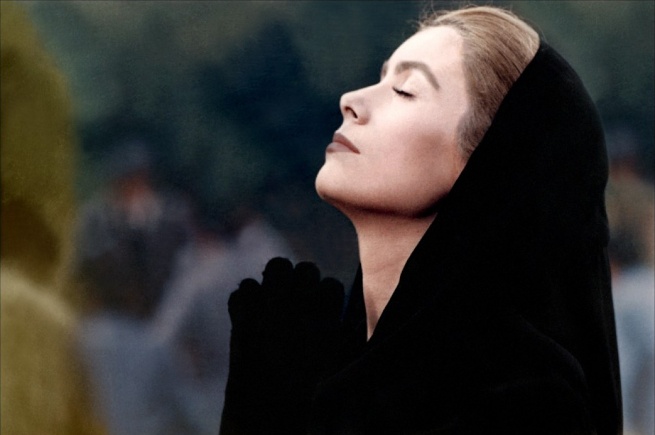
It returns the figure of the orthopedic leg, like the doll of Miroslava in The Criminal Life of Archibaldo de la Cruz (1954), it is very appreciable to be able to notice, always, a cinematography as compact as Buñuel's, always coherent and always faithfully continuing the path of his audiovisual language. Plastically manifests another of the director's obsessions, his particular portraits of Christian figures, which we will now have in the image represented by Tristana, leaning suggestively on a statue, apparently of a Supreme Pontiff, a characteristic Christian representation by the filmmaker. The director wanted to shoot unequivocally in Toledo, territory known for him, the filmmaker rejoices in showing the streets, plastically sinuous, zigzagging, like the interior paths of the characters, even Buñuel asserted that this was the only one of his films that could not have been filmed anywhere else than in Spain. By day, with light, and dark in the night, shady, the streets of Toledo, with their old architecture, house the characters, being exemplary that dark frame of old Don Lope retiring, beaten, humiliated, deprived of his toy, his object of desire. Thus, we have the detail, and returning with Tristana, of her always deciding between two options, generating ambivalences with grapes, columns, streets, she repeatedly rejects offers of marriage from Horacio, she has uncertain relationship with deaf and dumb Saturn; yes, her actions are sinuous, like Toledo streets, always crossroads, two roads, like Tristana and her taste for choosing between two options. It is also ambivalent their relationship, being both guardian and husband, being her wife but at the same time almost a maid, in a story where the servants have importance in their respective sordid universes, now it is Saturna, as in her moment it was Ramona, in Viridiana. Buñuel claimed that, thinking about it years later, he would have liked to have two different actresses to embody the two moments of Tristana, before and after the loss of her leg, a desire that will later materialize in That obscure object of desire (1977). Surrealism unfolds only in the final sequence, the only moment where the linearity of his story breaks, everything has been consummated, we have a bunch of rapidly concatenated sequences that summarize a good part of the film -novety in the director this resource-, and ending with the head of Don Lope again in the bell, a bell that acquires another meaning, since it sounded at the beginning, it is prologue and epilogue at the same time. In the end, Don Lope calls the clerics to his home, they drink chocolate, she, completely ruthless, ends up provoking his death, and in the novel, by the way, did not kill him, it is a detail of the director, who reflects his personal touch of individuals tasting chocolate, as the filmmaker in his life liked to do, with sugar cubes, one more time, the male character is a reflection, to some extent an alter ego of the filmmaker. The actors, both Rey and Deneuve, are of course at the height of the director, demonstrating why they were in those years his usual performers, in a film fully embedded in the final stage of Spanish, his french stage, a film that wanted to shoot a decade ago in Mexico, something that was frustrated after the scandal raised by Viridiana, but that then came to see the light. The great Buñuel had reached his final maturity, his style reached its final form, the final exercises of Calanda's genius would come.