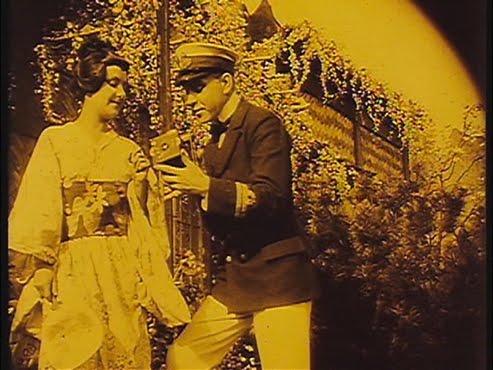
A unique film that we have on this occasion, from the time when an unforgettable giant of cinematographic art was still in formative years, 1919 was the year in which Fritz Lang would give the world his first works, his first steps as a filmmaker, and he would do that generating three films. This would be the third film of the giant director, after the debutante
Halbblut, and then
Der Herr der Liebesin, however it is this sadly the first in chronology that is still preserved to this day, a picture not without its curious and memorable details. Just to mention some of those details, this was a huge movie, initially planned to shoot in four films, in four feature films,
The Golden Lake would be the first, work for which Lang lost the offer of Erich Pommer to direct
The Cabinet of Dr. Caligari, the legendary mother film of German expressionism; later,
The Diamond Ship was produced, the second episode of the four, but that was the end of the project. The film, in any way, narrates the adventures of a wealthy aristocrat, who finds a mysterious parchment that informs of formidable treasures from the Incas in Peru; the parchment is stolen by the secret agency The Spiders, and he, along with other characters, will pass incidents in order to reach the fabulous treasure despite the spies.


A subject on an island throws a parchment in a bottle into the sea. Then, in a distinguished group gathered in San Francisco, Kay Hoog (Carl de Vogt) has found that parchment, the same one that a mysterious subject steals. Hoog, together with the beautiful Lio Sha (Ressel Orla), identify the thief as a member of the secret society The Spiders, and embark for the treasure that the scroll indicated was from the ancient Inca Empire. They arrive first to Mexico, while The Spiders embarks as well. Already in Peruvian lands, the Incas plan a human sacrifice and thus return their former lost imperial glory, Hoog and Sha are captured, he is saved by Naela (Lil Dagover), beautiful priestess of the Sun, who makes him escape from sacrifice. Hoog and Naela return to America, they get attracted, this unhinges Sha, who murders the priestess; Hoog swears revenge. Sha, leader of The Spiders, begins to make moves with her people to locate valuable diamonds, while Hoog looks for her and goes into Chinatown in search of information, and works with diamond tycoon John Terry (Rudolf Lettinger). Sha also continues to look for the jewels, there are trips by sea, they go into a cave, there are ancient corpses and jewels, there she finally finds Hoog, she catches him, but he escapes. Back in London, apparently Sha has died, and Terry finds his daughter, kidnapped.


This film is one of those classic works, one of those movies, that time has been aging and becoming works of not very easy access, and even more, of greater complexity in its complete and fair analysis due to the circumstances that have surrounded its production, and above all the destiny itself of the work originally conceived by its author. Yes, it is important, it is necessary to contextualize the feature film, although it sounds obvious, because contextualizing is a necessary step for any appreciation of an artistic work, that way we understand that by this film we stopped seeing this German giant at the head of
Caligari's project, is Lang before being Lang, before the giant was born, before Expressionism existed or was born as an artistic movement, before everything, before the master produced the enormous jewels that years later would come, and change the cinema forever. It is therefore this, a conjunctural feature, and forever will remain the unknown, the knowledge that Lang could have directed Conrad Veidt and Werner Krauss, and enlarge even more, if it applies and if possible, his huge figure, which is already extraordinarily adorned with works of the stature of
Doctor Mabuse (1922),
The Nibelungs (1924),
Metropolis (1927), all jewels of the seventh art. This is a film so unique that we will find a Lang still without his main cinematographic imprint, the most obvious of his audiovisual guidelines were not defined by then -although it is true that the domine would take almost nothing to do it, in reality-, not ceasing to be a remarkable moment to see a future master, even taking his first formative steps. So much so, that we see him embarking on a film of exotic adventures, filming those exotic adventures and peripeteias, in equally exotic settings, this at least in intention, because no less certain is that the film was not filmed in the ancient Peruvian land, the country that gave birth to the writer of this article, by the way. Not a few pretend to see in this film a future, perhaps a wink or a proem to the future Westerns that Lang would later shoot in Hollywood studios; but in any case, it is a very atypical picture, as atypical as it is appreciable.

So we see the Indians, the Incas, native Americans, exoticism in humans, and that exoticism will increase even more when entering the Chinatown, chinese neighboor, a greater variety in human elements, which also enhances that exoticism in the adventures, according to the media of the time, such as trips by sea, excursions to old abandoned caverns, even trips in a hot air balloon, remarkable adventures, in which we will even find magic and spells. As a brief parenthesis, another detail to note will be how the ancient races, the ancient civilizations, the Inca natives and the natives of Asia, both want a rebirth of their culture, they want their lost glory and power to be recovered. Similarly, Lang will try to capture, although with moderate success certainly, the Inca environments, the emperors children of the Sun, the ostentatious temples, with the conspicuous stones of multiple angles, heritage of humanity, everything configures a representation, something scarce of pomp and pageantry, of a millennial environment, lost. Also, for the same thing mentioned of austerity in the final representation, it also feels like a pending, as a lamentable waste, not having captured the stunning and majestic South American locations, the landscapes, the great Peruvian Andes, certainly not something allowed by the budget. Probably it was a prohibitive ambition to shoot in Cuzco itself, being a delight to imagine Lang in Machu Picchu; many years later, his countryman Werner Herzog, yes that would seat cathedra and school rolling immortal films in the Peruvian jungle. But continuing in that line, for that reason it is also noted a certain frugality in showing the temples, one of the wonders of the rich Inca culture, that was another of the details that highlighted the American culture, and ends up being another detail in which the picture was a bit short in its representation; the distance was evident, just to mention the difference of one art to another, with the Italian cinema and its overwhelming and epic realism, with its huge representations, light years ahead in that aspect of the German audiovisual vein. Preponderance is given to the raids, shootings, fights, actions, adventures, the vicissitudes are the center of everything, it is given primacy to this over greater technical skills, either in the management of the camera, or in manufacturing and use of large sets. This leads to a continuity, a causality in the actions that are the core of the film, unusual a feature of Lang in which the succession and linearity of events is so conventional, is largely an adventure film, where the adventures are everything, and where a soon, succinct and concise prolegomena unfolds. There, the first thing we see is an old man, without further explanations, introducing the old paper into a bottle, then throwing it into the sea; we do not have more information, but we already know that this paper is valuable, we already know that an adventure is coming, it is about to happen.


Speaking now of the technical quality, of the staging and realization of the film, the rigidity and visual and technical linearity will almost never be broken, we will observe very few resources that break that visual and narrative convention, just a few superimpositions of frames, as resources that break that plain. Few close-ups will be appreciated, almost always mid-shots and long-shots, few technical resources, it was a rookie Lang, it is very much a commercial product, it is a product born, thought of entertainment. Inevitable was also, given the nature and configuration of the story, that more than one wants to see previous elements of future adventure films, being the most daring who see here the decalogue, the canons of the genre of adventure films, future Indiana Jones serial pictures. It is said that the canonical elements are already here, the germ of that later contemporary stream of features seems to have been based on feature films like the present, and we appreciate the future genre of adventures and voyages, in the style of the aforementioned character if you want, that commercial style that is not where Lang stands out, and we end up appreciating a film that in the global result, feels flat, linear, conventional. Also, among the few other different resources, we have shadow games in some sequences in Asia, pressing and threatening the spiritual being to find one of the jewels that they seek; within the general austerity of the movie, that brief sequence is one of the segments that, with a certain timid air, remit -with lukewarmness but at least it does- to the expressionist darkness and twist. There is a seriousness in the staging, manifested, as was normal for the time, the end of the first decade of the last century -and the last millennium as well-, with a static camera, not very mobile, this we will see soon from the sober initial images of the gourmets, then a few first minutes that do not allow to appreciate much more technical virtuosity. It is very interesting to note, however, that, as already mentioned, there was a common incident of this film with
Caligari, Lang lost the opportunity to direct it, the project finally falling into the hands of Robert Wiene and generating the imperishable expressionist work that we all know; despite this, to that small disagreement, we can identify common visual elements, images that refer us to the film with
Caligari, such as the famous stairs, repeated staircases, as well as some chiaroscuros that refer us to the dark aesthetics of expressionism. Apparently, Lang drank from the same inspiring sources, after all. Some license will have to accept the history, the filmmaker, being the uppercase, the almost unforgivable fact of the idiomatic jump, seeing that an American explorer understands perfectly with an Inca native, a Quechua speaker; it is certainly a huge license, but it is the toll that we will have to pay, to overlook in order to appreciate the depth of the story. Another license, almost as great, is to see natives, Inca Indians still coexisting among contemporaries adventurous aristocrats, is the toll to see the history. It is unavoidable to point out that the present article is based on a very atypical work, because as it was said, The Spiders was composed initially of four stories, of which only two were produced, both audiovisual segments with a chronological space, with a separation of a few months; despite this, those are works that can be considered independent, lasting together, more than three hours. But the one who writes had access to another version, another cut, a cut that, frankly, I do not know exactly where or how it was born, and that has a duration, joining both chapters, of two hours and seventeen minutes, with obvious mutilations; an example undoubtedly of the aforementioned, the circumstances to which the years submit to features of the classical period, with different versions or cuts circulating. With the aforementioned, it is a pity, then, but we must consider that we have unfinished adventures here, the end of the second film,
The Diamond Ship, evidences that; it is said that even Lang had already prepared the scripts for the next two films, which completed the
cuatríptico, something that never saw the light. The film in a trial perhaps bitter, ends up being of greater value as a film born in a tessitura, as a trivia or cinematic curiosity, that as a cinematographic jewel itself, it is inevitable to finally feel the film as not one of the greatest productions of the giant German director. However, and although it goes without saying, Lang is a key director for the study of cinema, a fundamental part of the silent cinema, it is necessary to appreciate this conjunctural film, a moment in which then, in a certain way, the adventure film genre was born.


 The road to great masterpieces is being leveled, film by film, the first features by the master were flowing, who continues polishing his style, the great moment is expedited, the master learned as fruitfully as quickly his craft, in order to be able to generate this picture. A picture which is a serious work, but we can definitely say that the best was yet to come, for the filmmaker and the world of cinema, was just the fourth feature film by one of the greatest filmmakers that ever existed. The immortal master gives us one more proof, a preview, a proem from his youth, of the versatility that he would never stop exhibiting throughout his career, since exotic themes would never fail to attract him, as evidenced by the films he would make decades later , in the 50s, the diptych of The Tiger of Esnapur and The Indian Tomb, both of 1959. It is then a unique film, at the beginning of his career, which makes us understand from another perspective that great variety in styles, that versatility which Lang always showed throughout his filmography. Thus, and with that prolegomena, we are introduced into a world where honor is the priority, compliance with the rules and commitments that society establishes, where it is better to die with honor than to live with dishonor, a powerful determination that will lead to a tragic end. Is a story that concentrates a lot of Asian culture, Japanese culture, a classic, a very Japanese story, a story of intense feelings, intense sufferings, a universal classic of various arts, which seduced even the great Puccini. Speaking of the picture and its qualities properly, there is a factor that also keeps repeating, in this and the initial movies of Lang, something normal, and this is that, after a third of the film, we can notice that it is not a feature that overflows technical virtuosity, Lang apparently kept all that prodigious visual explosion, all that technical domain, for his expressionist moment, for the most powerful stage in that aspect of his career, already just a few years away. Similarly, there is another common factor to the films of this era of Lang, again, something completely normal, were the years of the liberation of the camera, and therefore the cinematographic language, I mean the development of the camera, is a static camera mostly, lacking movement, and, therefore, lacking in greater expressivity.