
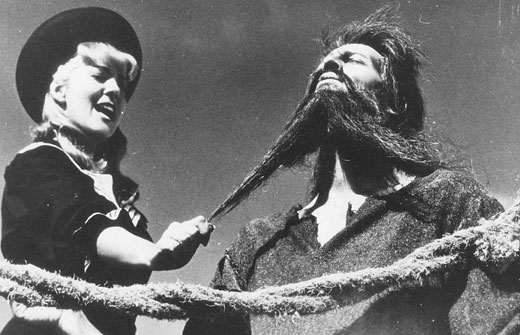
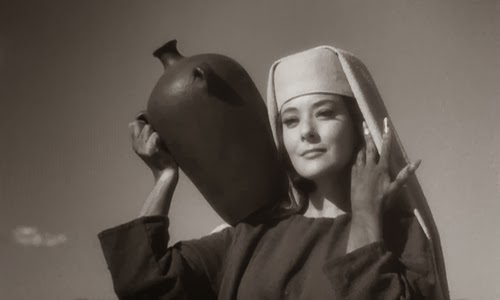
In the middle of the desert, there is a group of faithful, religious who in a small procession approach a large column among the aridity, on whose summit lives Simon (Claudio Brook). After rejecting his convalescent mother (Hortensia Santoveña), who wants him to live with her, and a promotion in his religious order, this man who seeks spiritual purification moves to another tower, which the faithful facilitate for his penance. After miraculously returning the hands to a maimed thief, a beautiful young woman (Silvia Pinal) appears, who approaches him, but does not interact. The young monk Matías (Enrique Álvarez Félix) then approaches to offer him food and water, which Simon receives sparingly. After fantasizing about going down to earth again, as well as with his mother, a beautiful young woman appears, who pretending innocence, dressed as a girl, shows her legs to the man. The religious then return with Simon, where one of them is possessed, to whom an improvised exorcism is practiced. Then comes a representation of Christ, but it is Satan, always with the appearance, hidden, of the recurrent woman. Simon continues to do penance, the faithful continue to worship him, until a coffin arrives in the middle of the desert, satan goes out again, the beautiful woman, who takes him to a surreal trip, to an American center of entertainment, where wild dancing they see, and where Simon stays.


With the present film, it will remain for the myth, almost for the legend, as the years progress, the real reason for the vicissitudes experienced in this shooting, incidents that directly affect the final result of the work, and that inevitably become indivisible from the film properly. Gustavo Alatriste, producer, is generally pointed out as responsible for the fact that this is finally an unfinished job, it is said that it was thought as a film of two, or even of three differentiated segments, with one each director in charge, but having finished the financial funds, the producer went bankrupt, and everything was cut short; however, many say that this is not the real version, among them Silvia Pinal, the then wife of the producer. In a special edition of the film, she assures in an interview that they tried Fellini to direct the other part, proposing the italian as protagonist his wife, Giulietta Massina; when Alatriste wanted to do the same with Pinal, she seems to have withdrawn support for the film, thinking naturally that if someone should direct her, it was Buñuel and only him; and so it would end up being, albeit mutilated. More or less plausible the hypothesis, it does not stop being that, a hypothesis, like so many others, among which are counted as possible partners in this film initially thought in episodes the aforementioned Fellini, the great Ingmar Bergman, Stanley Kubrick, or Orson Welles, a parade of the most select in the world of filmmakers were considered as alternatives to direct the second segment of the feature, discarding all of them for various reasons, not entirely clarified by the way. In addition to the actress, the photographer Gabriel Figueroa also commented naturally, all of them give us different versions, with different names on the possible director, always apparently Fellini taking some lead in the predilection of the other director of the film, a very human situation regarding comments, cross-versions, cover-ups to friends, because Buñuel never spoke badly about Alatriste, despite the fact that more than one considered him as a producer of very little seriousness. All this turns the film ungraspable to analysis, something unheard of, the financial problems were never a novelty in the filming of Spanish, especially in Mexican lands, but here they reach implausible ways, where professional film people, from different areas of the office, have all different versions of why this project was so violently frustrated.


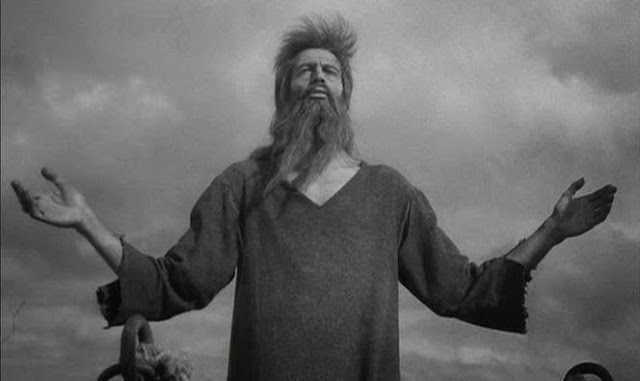


The film is therefore an unfortunate example of how the original ideas for a film are finally turned upside down, with greater severity, this being a sadly famous case, completely altering the real idea that the cinematic artist wants to convey. Only the epistolary relationship with his comrades allows us to follow up a little on what actually happened, but always with results that are not completely reliable, in which we can see that it was a film conceived as a feature film, divided into parts, and naturally there is a script, the original script where the planning was very different. Regarding the plans initially drawn, there are many scenes that had to be modified, and many others that were not even shot, something that, of course, interfered with the unity of the entire film, in its final result, a film that should have been composed of two, of three stories, a collection of possible directors, which was not even fully filmed, being presented at the Venice Film Festival of 1965, despite the expressed opposite desire of the filmmaker -ironically receiving a recognition, including a prize in the competition-, and generating the final negative of the spanish genius to finish the film. The well-known rigor with which the iberian shooted had insufferable budget difficulties here, besides the implacable conditions of the desert zone, we can even appreciate the undeniable difference of a cloudy sky with a blue sky in certain sequences, but that has been arranged, in the laboratory, as well as in the montage of the film itself, causing the story time to have elapsed; in spite of everything, some of these shortcomings are noticed. The severe aridity of the environment where the film was shot is immediately shown, which in turn reflects one of the biggest problems that arose during the filming, the climatic and geological conditions of the space where it was worked. Buñuel told us that although the Mexican studios were of unbeatable conditions, the filming equipment itself was in terrible situation, old equipment, creaking, almost obsolete. Necessary, however, was the use and disposition of a crane, to place the camera in mobile positions, to provide the necessary dynamism to its development, since with Simon all the time at the top of the tower, a developing of this dynamic and deploy in the camera was therefore precise. The game of low-angle shots versus high-angle shots, was something precise and necessary to represent with more forcefulness the figures, the crowd on earth, Simon on top of the cusp of the tower; in spite of the precariousness of the filming equipment of Mexican studies to which Buñuel referred, the crane was available to achieve those shots and framings.


The special effects were necessary for the initially planned, but due to budget problems, many sequences were omitted and were not shot. However, despite the inconceivable difficulties, this is a film very
his, fully identifiable, from his figures to his topics, we have religion, we have female legs, we have insects, ants -the entomologist always present- even when it was mutilated the feature, the hand of the filmmaker in the realization of the medium-length film can be notticed, something that a master can achieve. Yes, never, there will never be a Buñuelian film without the presence of female eroticism, specifically in the figure of a female stripping her legs, her thighs, extraordinary and appreciated detail by the filmmaker, ineluctable part of his cinematic language. We also have the dwarf, another previous element of Buñuel in
Nazarín (1959) -very close pictures indeed-, who dangerously has a behavior that borders on zoophilia, and he stars with Matías the recidivist phrase "The demons travel through the desert" ... "At night I hear them", they say to each other, inverting roles in the dialogue. In this regard, a religious triptych is completed, by the origins of the human drama, composed by the aforementioned
Nazarín,
Viridiana (1961), and the present film, although the final form of this closing of the triad, very far from the original idea of director and producers is. According to his sister pictures, the human sacrifice of the protagonist is in vain, in this case, the prodigy is in vain, divine things have no place in the world of vulgar humans, Simon performs the genuine miracle of restoring the hands of a faulty thief, only awakening in people the act of ignoring him, more interested one of them in eating bread than in the miracle they have just witnessed; even the beneficiary, the crippled, has as the first action of his recovered members, beating his daughter for annoying him, implausible. Simon has not a final rupture like Nazario and Viridiana, but again, how to know under these circumstances. The film is framed for moments in comedy, with humorous touches that are said to have been adapted due to the constraints of the shoot, always represented in Simón, and his witty and unexpectedly hilarious phrases that releases at certain moments. Interesting the figures adopted by Satan, a young girl, a girl, a witch, Christ himself, is a temptation in the form of the burning Pinal, always beautiful, discovering her legs -full buñuelism- and even her breasts in a very tempting way, but Simon resists stoically, except at the end. At the end we have the little surreal in the film, that sequence of the coffin wandering alone in the desert, containing the devil, her, a resource that reminds us who is behind the cameras. Also that plane, which in an almost dreamlike way takes both, Simon and the devil, unthinkingly to a nightclub, where unbridled dancing takes place, severe allusion to carnality, where one says
it goes retro, and the devil replies,
it goes ultra, two-faces opposition. That is the uncertain and violent cut, abruptly ends the film story there, we do not know what will happen with this new buñuelian element, Simón, things of shooting, that sequence had to be the improvised outcome for Buñuel, prey of the difficulties. Bizarre film, award-winning film, film consensually considered as a great work of its author, a film really necessary to enrich the knowledge of the work of this titanic spanish author.




 In his previous film, Diary of a Chambermaid (1964), Buñuel had finally been able to return to Europe, finally he could return to shoot in lands that could offer him certain resources that the Aztec film industries and areas could no longer provide. However, the return was not immediately absolute, having for the present film the director to returns shooting in Mexico, and this time under a group of circumstances that are probably the most unlikely among those that ever faced the director; certainly it was not seen, neither before nor later in his filmography, the ruptures between what was planned, and what finally took shape in this very unique medium-length film. In this story, whose script and story is the work of the filmmaker himself, in collaboration with his well-known partner Julio Alejandro, we are tried to be introduced into a group of stories about religion, being the one that concerns us, which should have been the first of them, the story of Simon, a man of faith who seeks to do penance to redeem his spirit, to suffer hunger, thirst and other torments on top of a tower in the middle of the desert, while the devil himself, adapting various forms, tries to seduce him and move him away from God. Very unique film, frustrated project, which is almost a mystery file, for not knowing for sure, completely, the reason for what the project has remained with its final form.


 In the middle of the desert, there is a group of faithful, religious who in a small procession approach a large column among the aridity, on whose summit lives Simon (Claudio Brook). After rejecting his convalescent mother (Hortensia Santoveña), who wants him to live with her, and a promotion in his religious order, this man who seeks spiritual purification moves to another tower, which the faithful facilitate for his penance. After miraculously returning the hands to a maimed thief, a beautiful young woman (Silvia Pinal) appears, who approaches him, but does not interact. The young monk Matías (Enrique Álvarez Félix) then approaches to offer him food and water, which Simon receives sparingly. After fantasizing about going down to earth again, as well as with his mother, a beautiful young woman appears, who pretending innocence, dressed as a girl, shows her legs to the man. The religious then return with Simon, where one of them is possessed, to whom an improvised exorcism is practiced. Then comes a representation of Christ, but it is Satan, always with the appearance, hidden, of the recurrent woman. Simon continues to do penance, the faithful continue to worship him, until a coffin arrives in the middle of the desert, satan goes out again, the beautiful woman, who takes him to a surreal trip, to an American center of entertainment, where wild dancing they see, and where Simon stays.


 With the present film, it will remain for the myth, almost for the legend, as the years progress, the real reason for the vicissitudes experienced in this shooting, incidents that directly affect the final result of the work, and that inevitably become indivisible from the film properly. Gustavo Alatriste, producer, is generally pointed out as responsible for the fact that this is finally an unfinished job, it is said that it was thought as a film of two, or even of three differentiated segments, with one each director in charge, but having finished the financial funds, the producer went bankrupt, and everything was cut short; however, many say that this is not the real version, among them Silvia Pinal, the then wife of the producer. In a special edition of the film, she assures in an interview that they tried Fellini to direct the other part, proposing the italian as protagonist his wife, Giulietta Massina; when Alatriste wanted to do the same with Pinal, she seems to have withdrawn support for the film, thinking naturally that if someone should direct her, it was Buñuel and only him; and so it would end up being, albeit mutilated. More or less plausible the hypothesis, it does not stop being that, a hypothesis, like so many others, among which are counted as possible partners in this film initially thought in episodes the aforementioned Fellini, the great Ingmar Bergman, Stanley Kubrick, or Orson Welles, a parade of the most select in the world of filmmakers were considered as alternatives to direct the second segment of the feature, discarding all of them for various reasons, not entirely clarified by the way. In addition to the actress, the photographer Gabriel Figueroa also commented naturally, all of them give us different versions, with different names on the possible director, always apparently Fellini taking some lead in the predilection of the other director of the film, a very human situation regarding comments, cross-versions, cover-ups to friends, because Buñuel never spoke badly about Alatriste, despite the fact that more than one considered him as a producer of very little seriousness. All this turns the film ungraspable to analysis, something unheard of, the financial problems were never a novelty in the filming of Spanish, especially in Mexican lands, but here they reach implausible ways, where professional film people, from different areas of the office, have all different versions of why this project was so violently frustrated.


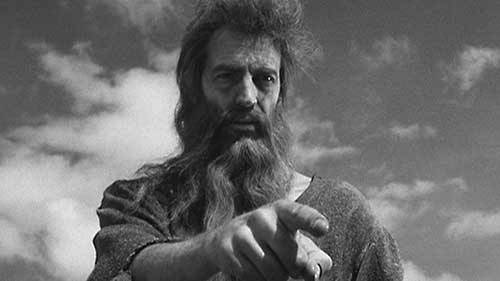


 The special effects were necessary for the initially planned, but due to budget problems, many sequences were omitted and were not shot. However, despite the inconceivable difficulties, this is a film very his, fully identifiable, from his figures to his topics, we have religion, we have female legs, we have insects, ants -the entomologist always present- even when it was mutilated the feature, the hand of the filmmaker in the realization of the medium-length film can be notticed, something that a master can achieve. Yes, never, there will never be a Buñuelian film without the presence of female eroticism, specifically in the figure of a female stripping her legs, her thighs, extraordinary and appreciated detail by the filmmaker, ineluctable part of his cinematic language. We also have the dwarf, another previous element of Buñuel in Nazarín (1959) -very close pictures indeed-, who dangerously has a behavior that borders on zoophilia, and he stars with Matías the recidivist phrase "The demons travel through the desert" ... "At night I hear them", they say to each other, inverting roles in the dialogue. In this regard, a religious triptych is completed, by the origins of the human drama, composed by the aforementioned Nazarín, Viridiana (1961), and the present film, although the final form of this closing of the triad, very far from the original idea of director and producers is. According to his sister pictures, the human sacrifice of the protagonist is in vain, in this case, the prodigy is in vain, divine things have no place in the world of vulgar humans, Simon performs the genuine miracle of restoring the hands of a faulty thief, only awakening in people the act of ignoring him, more interested one of them in eating bread than in the miracle they have just witnessed; even the beneficiary, the crippled, has as the first action of his recovered members, beating his daughter for annoying him, implausible. Simon has not a final rupture like Nazario and Viridiana, but again, how to know under these circumstances. The film is framed for moments in comedy, with humorous touches that are said to have been adapted due to the constraints of the shoot, always represented in Simón, and his witty and unexpectedly hilarious phrases that releases at certain moments. Interesting the figures adopted by Satan, a young girl, a girl, a witch, Christ himself, is a temptation in the form of the burning Pinal, always beautiful, discovering her legs -full buñuelism- and even her breasts in a very tempting way, but Simon resists stoically, except at the end. At the end we have the little surreal in the film, that sequence of the coffin wandering alone in the desert, containing the devil, her, a resource that reminds us who is behind the cameras. Also that plane, which in an almost dreamlike way takes both, Simon and the devil, unthinkingly to a nightclub, where unbridled dancing takes place, severe allusion to carnality, where one says it goes retro, and the devil replies, it goes ultra, two-faces opposition. That is the uncertain and violent cut, abruptly ends the film story there, we do not know what will happen with this new buñuelian element, Simón, things of shooting, that sequence had to be the improvised outcome for Buñuel, prey of the difficulties. Bizarre film, award-winning film, film consensually considered as a great work of its author, a film really necessary to enrich the knowledge of the work of this titanic spanish author.


