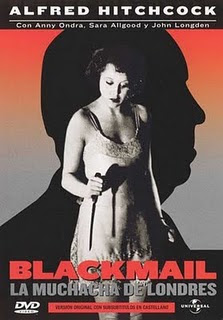
 Historic picture, memorable film work, the first spoken movie by giant filmmaker Alfred Hitchcock, and according to a statement not entirely clarified, the first talkie of British scenario. One of the greatest revolutions in the history of cinema had arrived just a year earlier with The Jazz Singer, many master filmmakers were in uncertainty about it, but this was not the case for Hitch. Studios had entrusted him the task of finally introducing the sound on a feature, and the master of suspense did much more than a mere experiment. As usual, Hitch adapts a literary work, in this case the play by Charles Bennett, with which continues the filmmaker finding the suspense as his major hallmark as an audiovisual artist. The story itself is simple, a woman, when almost being violated by an artist, in self-defense kills her attacker, and scared and fearful of what she has done, moves away from the atmosphere of what happened; but she does not suspect her boyfriend, a police officer, has been assgned with investigating the case, while a witness of the events begins to blackmail them. Still with the obvious insecurities and proper experiments of such a significant moment in the history of cinema, Hitchcock sets up an attractive film, not extraordinary, but essential for the lover of his films, is his first sounded movie.

 The film begins with some individuals, policemen who burst into a house and capture a subject, resting in bed, without much resistance despite having a gun, he is arrested. Then we see Alice White (Anny Ondra), she walks with her boyfriend, Detective Frank Webber (John Longden), they are going to eat, but in the place they go, another character appears, a man (Cyril Ritchard), to whom she immediately makes a signal, she gets rid of her boyfriend, and meets with the second subject outside. She agrees to go to the house of the man, who is an artist, and in the midst of his paintings and piano music, he kisses her, tries to get intimate with her by strength, and Alice, to avoid it, kills him with a knife. Then, she leaves the house of the artist, terrified of what she has done, and the next day, during police proficiencies, Frank, in charge of the case, finds one of her gloves at the scene of the crime. When Frank tells Alice that he knows what happened, and thinking to cover her up, appears Tracy (Donald Calthrop), is the subject initially arrested, who witnessed what happened, and that immediately makes clear his intentions to blackmail them. Tracy, controlling the situation, achieves Alice even to take him to her home, to eat with his family, blackmails her with what he knows, but Frank, learning the rap sheet Tracy has, does not give in to blackmail, and finally gives solution to the exigent circumstance.


 In the beginning we appreciate a camera denoting a little frenzy pace, not excessive, but some bold camera movements give the moderate haste to opening sequence, in which the assembly work also does the same to create that environment. To this, it adds some other camera movement and zoom, in which is evidenced again the mastery and ease on the technical level that always had the British, showing it agile, fast, accurate, exploring minute details like a mirror hanging in a wall, its accuracy is remarkable. It is curious that the first sequence has been completely silent, we see the actors moving their lips, but there is no audio of their voices. The personal print of Hitchcock is recognized almost immediately from these early sequences, his language, his narrative resources, when we see an ashtray, first with a single cigarette burning, then packed with several cigarettes, exposing the time spent in that tense situation, the arrested man is being registered in police files. As always, since his inception in silent films, Hitch was enthusiast and talented to tell without words, to narrate with images, not only for the detail of the ashtray and subsequent visual displays, but by the behavior of the camera. It is noted, as was obvious and natural, that these were the first sound exercises by Hitch, and in that sense are evident the insertions of sound, the director to some extent was experimenting, the British International Pictures studios entrusted his whiz kid, Hitch, who was then 30 years old, to take the English cinema to the new world of sound. The master of suspense does it, and is notticeable, as was natural at such a crucial moment, certain lack of coordination, as the sound, the audio of the actors's voices sometimes not being synchronized with the movement of their lips, the insertion feels a little forced. Diegetic sounds also denote certain artificiality in some scenes, some untidiness in editing, but, again, we must consider that Hitchcock is the master who makes what is probably the first British sound film experiment.


 Among the sequences that depict the sound leap, we have prolonged birdsong background while she changes her clothes, the day after the murder. All deficiency -lower, by the way- gets relegated, because these are mythical moments, the master Hitchcock first conducting a talkie, and English cinema itself was entering another stage, with the beautiful Anny Ondra as one of those first voices to be heard, with her notorious Eastern European accent. The Austro-Hungarian actress exceeded certain insecurities due to that accent of her, to finally overcome the audition Hitch did, and get this role. Looks beautiful the Ondra in simile character to the immediately previous film by director, The Manxman, released the same year, 1929, with similar behavior, cheerful, coquette, with an innocence which in turn is combined with certain malice to manipulate men (she gets rid of her boyfriend to finish in the artist's home), a feminine duality feature of many Hitchcockian females, and collaborating with many who accuse him of misogynist. She becomes undisputed center of events, engine generating everything, there are plenty of close-ups exploring her beautiful face, her gestures, her innocence and banality at the beginning, her fragility and terror over the blackmail later, and Ondra gets more than just a passing grade in the difficult exam. It is understandable that she became the first blond muse of Hitch, and has the great privilege of having closed the silent phase of the filmmaker, with slightly above-mentioned film, The Manxman, then opened the sound stage of English giant; certainly meritorious, privileged place of the Austro-Hungarian actress. Known is the matter of this film having two versions, one still silent version, and the other sounded -in which this article is based on-, a widespread custom in cinema for those years when the filmmakers, and especially producers, were skeptical about the arrival of sound, and produced two versions of each feature, to foresee or counter any eventual failure of the audio version of any film made. This detail skews to some extent a comprehensive appreciation of this film, and not having yet viewed the silent version, I am constrained to comment on the talkie.


In this, the first sound film by Alfred Hitchcock, still the successes and mastery of silent cinematic techniques outweigh the benefits of his talkies, it is completely normal, natural, and among these successes we have the sequence of her, after murder, mechanically walking the streets. There we appreciate the darkness, the shadows, the assembly again, people passing rushed to her side, visual tricks show us her inner torment, all urban details remind her crime, always without words; certainly the silent filmmaker still expressed more, the sound filmmaker was just being incubated. Notable film in which Hitchcock still continues to discover his great topic, suspense, which is cleverly spread from murder, a film in which, by the way, other vital issues in British genius's cinema are absent. Thus, although it lacks the love triangle, or the issue of false guilty, we do have the topic of murder, almost indivisible from whole Hitch's oeuvre. Hitch also enfolds us in a halo of voyeurism, when we appreciate only partially crucial facts, first only see the shadows of them on the wall struggling, then the curtain that separates us from the action, he trying to outrage her, we wonder exactly what is happening. Then the camera shows the detail of the knife, making easier enough to imagine what happens, and most obvious being the result of the action when we see the hand of the aggressor out of that curtain, hanging lifeless. Some sort of technical divertissement Hitchcock allows, as the upward traveling at the time Alice and the artist go upstairs, recognizable details in the artistic personality of the director, as well as the warm eroticism that more than once exhibited, this time with the beautiful Ondra changing her clothes at the artist's home. Naturally, we also appreciate other never absent visual resources by filmmaker, as his traditional image overlays at different times of the picture, and with different intentions. But the fact is that these elements are rare in the film, of course, the supreme novelty of the sound seems to have captured the attention of the master, and probably of his entire production team. Also we found some unusual and attractive element as a theatrical halo, detected in the important sequence in which Alice, Frank and Tracy speak directly of the situation, blackmail and the possibilities of who would believe the police. At such times, the composition of these scenes conveys that warm theatrical treatment, distribution of the characters in the frame transmit that feeling, certainly positive. Essential film for lovers of Hitchcock's movies, and cinema lovers in general, his first sound work, a new era was starting, Hitch had already matured at some extent, already dominating resources, and now, with the domain of sound, would reach highest levels of cinema, the genius had a clear track.


