Abbas Kiarostami is one of the most notorious artists of contemporary international film scene, with a reputation and prestige-earned by not a few memorable films, among which are those that make up the so-called trilogy of the earthquake, work that is now complemented by Through the Olive Trees (1994), which earned him admiration and gained global prominence. For this occasion, the Iranian filmmaker presents a feature which on the technical side is fully identifiable, recognizable as a work of its author, in which many of his staging guidelines continue to shine clearly. The film has some inspiration from the eponymous poem by Forough Farrokhzad, and tells the simple story -as always in Kiarostami- of an engineer who travels to the Iranian village of Siah Darre, with intentions not entirely clarified, and the film will be the representation of the experiences of that individual in that locality. Coming from Teheran, his customs clash with the local ones, he will try to accommodate them, with very relative success. This film is another example of very significant pictures made across the ocean, in middle East lands people can also produce this art, and high quality; a very different art from the ostentatious display that is generally seen in the Western context, whether American or European. It is a cinema full of visual beauty but not devoid of meaning and interesting figures, and this work is a good representative of that beautiful cinema to which we are healthily accustomed by this great director.


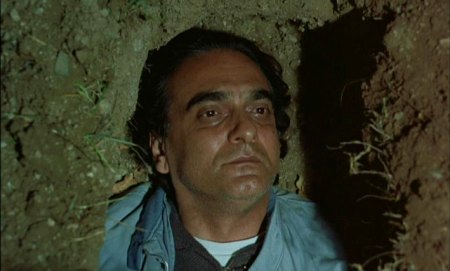
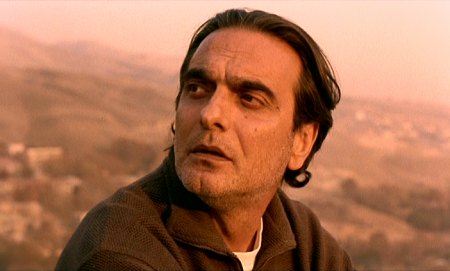
The film begins with a moving vehicle with two individuals, in the midst of a winding road, amid sandy dunes, looking for the way to Siah Darre, which is unknown for them. In the car, goes the engineer Behzad (Behzad Dorani), who meets the child Farzad (Farzad Sohrabi), infant that was expecting him, since having a common acquaintance. Once at the site searched, all local people are very hospitable and reverent with the engineer, which does not prevent many of his customs and devices, such as car and cell phone, to irritate the locals and make him feel out of place, believing some that he is actually looking for a treasure or something similar. Farzad is teaching him around, speaks of an extraordinarily long-lived elderly woman, while the engineer constantly tries to communicate by phone, having to climb headlands to get signal. Later, he gets, from a digging individual, a human femur, while continuing his stay in Siah Darre. Farzad is his closest friend in that place, but after treating him badly at some point the visitor, the infant goes away from him, he withdraws his friendship; Behzad then finds the same character, the excavator in trouble, fell and got buried alive, and he participates in his miraculous rescue. In the end the stranger talks to the local doctor, photographs some women, gets rid of the femur obtained, without showing more of his journey.


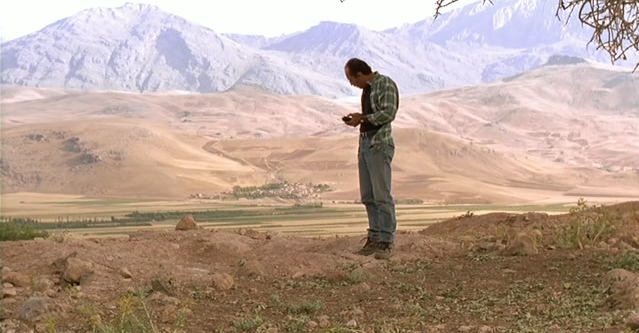
 Kiarostami's style still feels identified with his oeuvre on this feature by keeping the guideline of a very close-to-documentary work, which is not too surprising knowing that Iranian does not produce only feature films but also short films and especially not a few documentaries, where the constant director's north shows in his stagings. However, the film does not fully land in that genre, it actually points beyond. The film glides us messages very specific and well-integrated to the development of the picture. A key scene in the film comes to be when the engineer shaves, closer than ever to the viewer, the engineer does not have mirror where to look at, or rather, the mirror where he looks is us, the spectator himself is the one who becomes a protagonist's critic. Kiarostami turns us into his character's critics, egotistical individual who despite his efforts does not ends up curdling in the locality where he is alien, showing not very laudable attitudes. His lack of empathy is evidenced when he unjustly mistreats the small and noble Farzad, then offers flimsy excuses, nothing concrete, to the child, the innocent child who had previouslly expressed how a kind fellow he considered Behzad was; the stranger even mistreats a turtle, in a figure that diagrams how he never understood the nature of the site where he was arriving. Turtle gets up and continues his journey however, life does not stop at human infamy. Hailing from a city full of technology, can not be integrated, does not understand the simplicity and beauty of that place, where he never ceases to be a foreigner.


 The engineer is naturally the main thread of the film, because although the visual beauty and the portraits of the land and its people are an important part of the picture, it is through him that befall the main events, his attitudes change. It is seen on the feature also the relative influence of the poem on which it is based to some extent, those verses are recited in significant moment. Among the notable moments of the film we have the figure of Behzad talking underground with the excavator, who he reaches that human femur illustrating the final sequence, and generating the encounter of the engineer with his girlfriend to get milk. It is the moment when the verses are recited, again in the underground, in the dark, with barely visible female milking a cow, in this unique circumstance and place poetry flows in a context apparently so alien to such activity. The symbolic fact of bearing the human femur is also slid, and the final silent shows the engineer getting rid of the bone piece, as if he was deleting something more of that land, setting an admittedly uncertain, but beautiful ending. In the cinema of Kiarostami, an inadequate palate can perceive that "not much happens", in this case may be thought that the film is more of the same stuff by filmmaker, does not add nothing; but beyond that superficial and apparent simplicity and austerity, powerful messages and convictions are warmly enunciated, from that simplicity the film amalgams to the beauty that hides his land, as we perceive some of his beliefs of human nature. It arises from East this singular sort of easterly neorealist, who dispenses actors, which dispenses with special effects and dizzying technical scenarios. His stage, his "trick" is reality itself, that displays solvent and beautifully. The wind will take us is another brick in the construction which is remarkable filmography of Abbas Kiarostami, one of the most attractive filmmakers of today's international film scene.